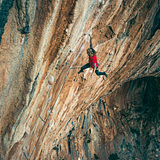
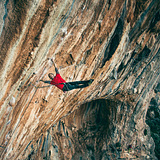
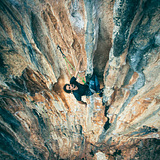
The cave itself (and the moves it demands) are so impressive that even those who just come to watch leave inspired. These striking features, combined with the fast approach, make the sector relatively popular and often crowded during peak times.
If the parking area is already full when you arrive, it might be worth considering one of the nearby sectors instead. Getting up early is always a good idea, as the sun hits the wall around midday. Depending on the season, a late session could also work well: with longer days and the shade returning around 16:00, you can still enjoy several good hours of climbing in the afternoon.
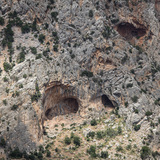
Crash of Titans is an unmistakable cave, clearly visible from the road and the parking area below, with its striking overhanging walls encircling the sector. It stands out as one of the few truly steep and high-quality climbing areas in the Leonidio region.
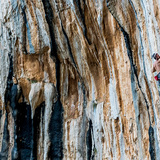
While most of the “real” caves around here often suffer from mediocre rock quality, Crash of Titans delivers solid, steep limestone that’s both aesthetic and challenging.
A particularly cool feature of this sector is that the entire steep central wall is completely rainproof, making it one of the very few fully accessible and climbable crags during long rainy spells, a true gift for dedicated climbers when the weather turns bad.
Sala is known for hosting some of the finest 7b routes in Leonidio, but the sector offers a wide spectrum of grades, making it appealing to a broad range of climbers. The climbing style here is typically finger intensive, with a strong focus on power endurance, offering sustained and rewarding lines.
As with many other AOS-equipped sectors, some routes are bolted quite close together. This is largely due to the nature of the financed bolting model used at the time, where the number of routes, rather than the overall quality, determined the compensation. A classic example of how Greek route development has sometimes favored quantity over refinement.
Despite that, Sala remains a must visit crag with solid rock, beautiful lines, and a memorable climbing experience.
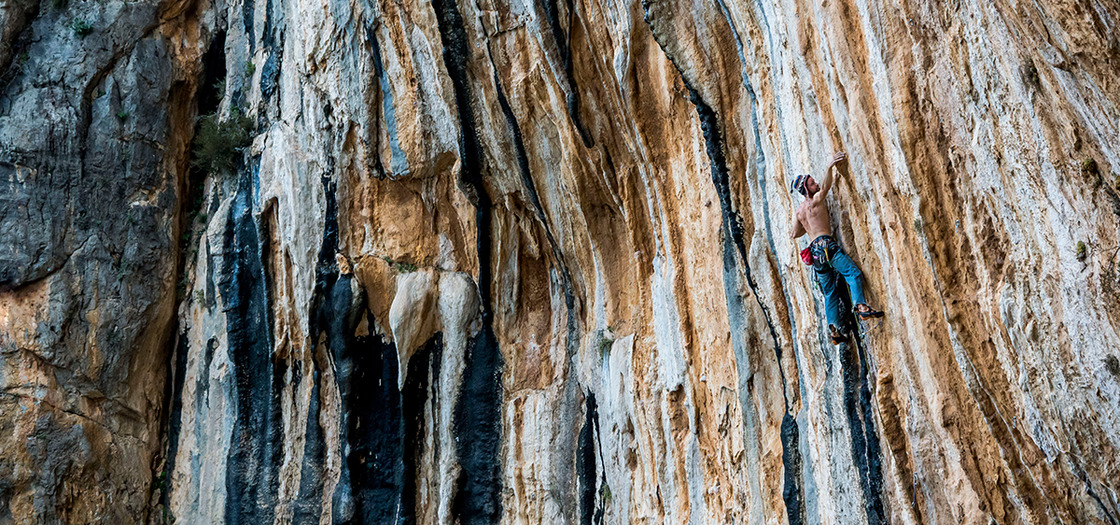
Almost the entire sector was bolted in 2013 by the Athenian Mountain Club A.O.S. as part of their EU-funded program.
The team—Stamatis Konstantakopoulos, Kostas Roussos, and Spirous Kouthouris—was responsible for establishing a large number of king lines in both the Leonidio and Athens areas.
They received funding twice through an EU initiative called Parnonas, enabling two significant waves of equipping. After the initial development phase, long-term resident Micha Schreiber added several fantastic new lines. In more recent years, I’ve rebolted some key sections of the sector where it was necessary.
Work is still ongoing
Crash of Titans is one of the standout contributions from Micha Schreiber and Christian Wahle, who bolted most of the sector during the spring of 2016. I still remember hearing the sound of their drills echoing through the valley and catching sight of them hanging high in the massive cave on my very first day climbing in Leonidio, as I walked past on the way to Twin Caves.
Sector Sala again is part of the two EU-funded bolting programs secured by the Athenian Mountaineering Club (AOS). While these programs helped expand the climbing infrastructure quickly, they also came with compromises.
As a result of the rushed equipping, you'll notice that the anchors on the main wall are all placed at exactly the same height, with little regard for what the rock naturally offers in terms of features or flow. Route cleaning and refinement were largely left to the local climbing community, a common story in sectors developed under funding pressure.
Despite these quirks, all three sectors have matured into well-known climbing destinations, each with its own character and backstory. Enjoy !