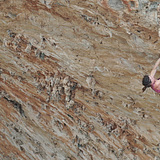
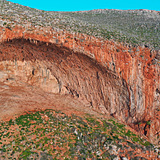
Tersanas Cave is a true tufa and stalactite wonderland. It remains remote and almost abandoned, requiring a genuine bit of effort just to arrive at its base.
The bolting here reflects the philosophy of honest climbing. Unlike modern, fully-funded "tourist" crags where bolts are placed every 1.2 meters without regard for the flow of the route, the protection at Tersanas is intentional. Bolts are placed where they are truly needed, respecting the natural language of the rock rather than adhering to a standardized grid. You'll exclusively expertly crafted lines that prioritize the climbing experience over mass accessibility.The lines are consistently challenging, regardless of the grade. While the difficulty is high, the rock quality, setting, and sheer beauty of the movement are among the finest you will find anywhere in the country.
Equipping lines in Tersanas cave reflects the harsh reality of climbing in a marine, tufa cave environment.
Bolting began around 2010 by V. Koutoupis, Ch. Tsoutsias, A. Mavromatis, and Th. Xtenas. At the time, most lines were equipped with A2 stainless steel.
Due to the cave's proximity to the sea and its internal drainage system, the A2 steel proved insufficient. Within just a few years, the bolts showed significant rust with accelerated oxidation of the steel by the salty air and strong winds. Another topic of the place is the calcite residue. Water seeping from behind the first layer of rock left mineral deposits on the hardware. Doesn't compromise the metal as much as the rust but for sure doesn't look inviting.
Pro-Tip: You can often scratch these calcite deposits off the metal using a brush, your fingernail, or even a carabiner, depending on how thick the buildup has become.
I began rebolting on the line Knock-Out using Titanium glue-in bolts in 2023. That same year, Vassilis Koutoupis upgraded two additional lines with Titanium.
Ongoing work in 2026 aims to have the majority of existing lines "clothed" in brand-new Titanium.
Technical Note: Working in such steep terrain is physically exhausting. Using a high-performance adhesive like Hilti HIT-RE 500, which can cure even in wet conditions, is highly recommended for these damp cave environments.