Blagaj Climbing Area
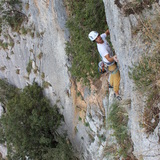
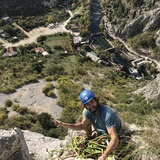
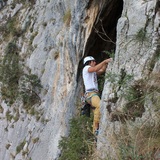
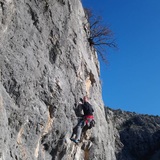
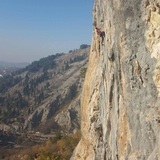
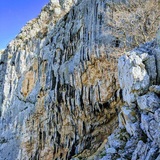
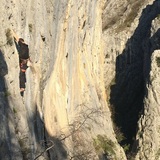
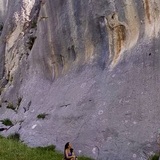
This relatively new climbing area has quickly become one of the biggest, most beautiful, and most diverse crags in Bosnia and Herzegovina. It stretches for about 2.5 kilometers along the limestone cliffs that rise above the cozy village of Blagaj, just a short walk from the stunning spring of the Buna River – a powerful, icy stream that bursts straight out of a 200-meter rock wall. Right beneath the cliffs lies Tekija Blagaj, a 16th-century Dervish monastery and UNESCO World Cultural Heritage site.
Thanks to its geographical position, mild climate, and sector orientation, climbing in Blagaj is possible almost all year round. Routes are graded on the French scale, and there’s something for everyone: from old-school slabs with tiny edges that demand maximum precision and delicate footwork, to modern, pumpy overhangs that test pure power and endurance.
The Rebro sector is climbable year-round, while winter climbing is best in the sunny sectors like Pejotl (A), Pčelinjak (B), Ljut (C), Crvena stijena (D), Duga peć, Karantena (E), and Vučije Točilo (H). On warm days you can often climb here in just a t-shirt – unless the wind picks up. In summer, however, it gets scorching hot by 10 a.m., so the smart move is to head into the shady canyon sectors: Hladovina (K), Publika (J), and Ispod Vodopanac (M). These spots often catch a breeze and provide much-needed shade. And if it’s still too hot, just dip into the Buna spring – probably one of the coldest swims you’ll ever take!
Rock & Route Characteristics
Rock type: High-quality limestone with exceptional variety.
Route style: From easy warm-ups to hardcore testpieces.
Route length: 15 m single pitches up to 200 m multipitches.
Total routes: ~250 (grades from 3 up to potential 8c+).
Gear: 70 m rope + 15 quickdraws recommended.
Bonus tip: Watch out for the goats that roam the crag, always wear a helmet, and respect the nature around you.
Welcome to Blagaj
Where history clings to the cliffs and the present climbs them.
Just 12 km outside Mostar, on the banks of the crystal-clear Buna River, lies the magical town of Blagaj. Once the medieval heart of the Hum region, Blagaj became the cradle from which Herzegovina emerged in the mid-15th century.
Blessed with a Mediterranean climate — thanks to its proximity to the Adriatic and its low altitude — the town basks in around 250 sunny days each year.
The scenery here is nothing short of spectacular: the powerful Buna spring (one of the strongest in the world), the serene Dervish Tekija, the commanding Stjepan-grad Fortress, the noble Velagićevina complex, and a landscape that has inspired travelers for centuries.
The Arrival of “Rocks”
In 2014, Blagaj gained a new identity — one built not just on stone walls of history, but on walls for climbing.
That autumn, Bosnia’s most accomplished sport climber, Salih Mulaosmanović, arrived and instantly recognized the vast untapped climbing potential in the limestone slopes above the town.
With the help of friends and curious locals, the first sectors — Pejotl and Pčelinjak — began to take shape. At the same time, Salih and the New Wave Youth Club built two artificial climbing walls in the Eco Centre Blagaj, establishing a training base and a launchpad for future development.
From Sectors to Sectors
Winter 2014/2015 brought the dramatic Crvene stijene sector, opened with renowned climber Quentin Chastagnier, and prepared approaches for future crags.
By spring 2015, the first bolting weekend brought together ASPK Neretva, led by Vedran Ugljen, and PD Željezničar, marking the start of important national collaboration.
That autumn, legendary alpinist Silvo Karo visited, leaving behind the fierce Ljut sector.
The Canyon Vision
The rugged beauty of Vulin Potok canyon revealed itself as the crown jewel. But to unlock it, safe access was essential.
In winter 2015/2016, with the late Ibrahim Balalić and many others, Salih built the Via Ferrata “Vulin Potok” — the backbone of Blagaj’s climbing infrastructure.
The following years were a whirlwind:
2016 — Sector Rebro opens.
2017 — Third bolting weekend yields Publika, Hladovina, Ispod Vodopanac, and the first multi-pitches, later forming Duga peć.
Shortly after — Vučije točilo and Šube, two of Blagaj’s finest sectors, come to life.
Winter — Via Ferrata extended to connect the entire canyon.
Hard Lines & New Standards
Spring 2018 saw the birth of Ihsan in Šube — one of the hardest tufa routes in Bosnia and Herzegovina.
Around this time, Wanja Reichl arrived. His contribution was transformative: opening hard lines in Vučije točilo, Šube, and Crvene stijene, raising the technical and aesthetic bar for route development in the area.
Growth Through Community
From 2018 to 2020, climbers from across Bosnia and abroad visited, enriching the local scene.
The summer of 2020 marked a turning point: a wave of young locals joined the climbing club, giving the area a new generation of guardians.
Even the pandemic years were productive:
Karantena sector opened by ASPK Neretva with international help.
A climber’s shelter was built in Rebro, strengthening ties between clubs.
In 2021, the Balkan Colours bolting course opened the Gavran sector and added new routes.
Today
As of summer 2025, the Blagaj climbing area proudly boasts:
15 climbing sectors
240+ equipped routes
Via Ferrata “Vulin Potok”
Climber’s shelters at Rebro and Vučije točilo
Several marked hiking trails
The Sport Climbing Club “Blagaj” now maintains and develops the area, supported by a community whose dedication has turned a dream into one of Bosnia and Herzegovina’s finest climbing destinations.
A Grateful Ascent
None of this would have been possible without the selfless efforts of climbers, locals, and friends from near and far.
From the bottom of our chalk bags — thank you.
— Sport Climbing Club Blagaj
www.blagaj-climbing.com